Swallow Guide: An In-Depth Overview
Swallows, known for aerial grace, encompass diverse species—from barn to cliff varieties— exhibiting unique nesting and foraging behaviors.
Their swift flight and insectivorous diet make them valuable allies in pest control, captivating observers worldwide with their acrobatic displays.
What is a Swallow? ー Defining Characteristics
Swallows are readily identifiable passerine birds celebrated for their streamlined bodies, long pointed wings, and forked tails – adaptations perfectly suited for aerial insect hunting. These birds exhibit remarkable agility in flight, often seen swooping and diving to capture prey mid-air. Their plumage typically displays iridescent blues, greens, and reds, though variations exist between species and with age.
A key characteristic is their wide gape, enabling them to efficiently snatch insects during flight. Swallows are highly vocal, communicating through a variety of chirps, trills, and whistles. They are generally small to medium-sized birds, ranging from approximately 5 to 7 inches in length, depending on the species. The term “swallow” itself interestingly shares etymological roots with the verb “to swallow,” potentially linked to their feeding habits and even the bird’s association with the throat or gullet.
Swallow Taxonomy and Classification
Swallows belong to the family Hirundinidae, within the order Passeriformes (the perching birds). This family encompasses around 78 species distributed globally, with the greatest diversity found in Africa and Asia. Traditionally, swallows were broadly categorized, but modern phylogenetic studies, utilizing DNA analysis, have refined their classification.
The Hirundinidae family is further divided into several genera, including Hirundo (barn swallows), Tachycineta (tree swallows), Petrochelidon (cliff swallows), and Riparia (bank swallows). These genera are distinguished by variations in nesting habits, plumage, and geographical distribution. Within each genus, species exhibit subtle differences in size, coloration, and vocalizations. The classification reflects evolutionary relationships, revealing how different swallow groups diverged over time. Understanding this taxonomy is crucial for conservation efforts and accurately identifying these fascinating birds.

Types of Swallows
Diverse swallow species, like barn, tree, cliff, and bank swallows, showcase remarkable adaptations. Each type exhibits unique nesting preferences, foraging strategies, and distinct physical characteristics, enriching avian biodiversity.
Barn Swallow (Hirundo rustica) ⸺ Identification & Habitat

Barn Swallow (Hirundo rustica) ⸺ Identification & Habitat
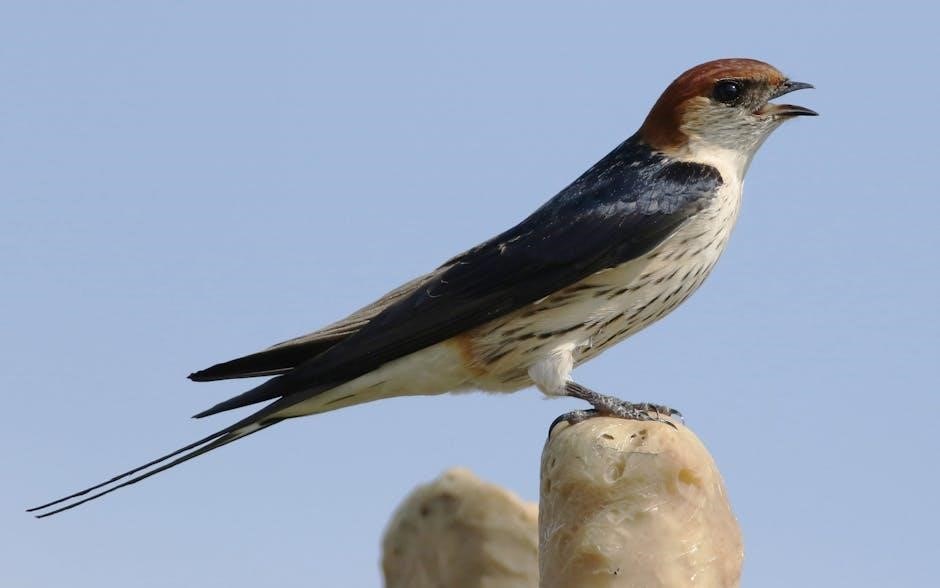
Barn Swallows are readily identified by their deeply forked tails, iridescent blue upperparts, and reddish-brown foreheads and throats. Their undersides display creamy white plumage, often with dark spotting. These graceful birds measure approximately 19-22 cm in length, with a wingspan of around 32-35 cm;
Habitat-wise, Barn Swallows demonstrate a strong association with open habitats, frequently nesting in barns, under bridges, and within other human-made structures. They also utilize natural cavities like caves and cliffs. Their global distribution is extensive, breeding across North America, Europe, Asia, and parts of North Africa. They prefer locations near open fields and water sources, providing ample insect prey.
These adaptable birds are often seen soaring effortlessly, skillfully catching insects mid-air. Their presence is a common sight in agricultural landscapes, where they provide a valuable natural pest control service. Barn Swallows are highly social, often nesting in colonies, and their cheerful chirping adds to the ambiance of rural settings.
Tree Swallow (Tachycineta bicolor) ⸺ Nesting Behavior
Tree Swallow (Tachycineta bicolor) ー Nesting Behavior
Tree Swallows exhibit fascinating nesting behaviors, often utilizing pre-existing cavities or nesting boxes. Unlike many swallows, they don’t construct gourd-like nests. Instead, they gather grasses, feathers, and other soft materials to create a neatly lined nest within the chosen cavity. These birds are known for their territoriality during the breeding season, vigorously defending their nesting sites from rivals.
Pair formation is typically monogamous, with pairs often returning to the same nesting site year after year. Nest building commences in spring, and females typically lay 5-7 creamy white eggs. Both parents participate in incubation, which lasts around 12-16 days.
Cooperative breeding has been observed in some populations, where helpers assist the breeding pair with nestling care. Tree Swallows are cavity nesters, readily accepting artificial nest boxes, making them a popular subject for ornithological studies. Their adaptability and relatively early arrival on breeding grounds make them a welcome sign of spring.
Cliff Swallow (Petrochelidon pyrrhonota) ⸺ Colonial Nesting
Cliff Swallow (Petrochelidon pyrrhonota) ⸺ Colonial Nesting
Cliff Swallows are renowned for their highly social and colonial nesting habits. They construct unique mud nests, often clustered together on vertical surfaces like cliffs, bridges, or the eaves of buildings. These nests are gourd-shaped with a narrow entrance, built by both sexes, but primarily initiated by the male. Colonies can range from a few pairs to hundreds, creating a bustling and visually striking spectacle.
Colonial nesting provides several advantages, including increased protection from predators and enhanced foraging efficiency. However, it also leads to intense competition for nesting sites and resources. Cliff Swallows exhibit strong site fidelity, frequently returning to the same colony year after year.
Nest construction is a communal effort, with birds often “helping” neighbors with nest building, though the exact reasons for this behavior are still debated. They typically lay 3-5 white eggs, and both parents participate in incubation and chick rearing. The close proximity of nests within a colony fosters a dynamic social environment.
Bank Swallow (Riparia riparia) ー Burrowing Habits
Bank Swallow (Riparia riparia) ⸺ Burrowing Habits
Bank Swallows distinguish themselves through their unique nesting strategy: excavating burrows in sandy or loamy banks along rivers, streams, and ditches. Unlike many swallows that build open-cup nests, Bank Swallows create tunnels, typically 5-10 inches long, leading to a nesting chamber. This burrowing behavior offers protection from predators and the elements.
Colonies of Bank Swallows can be extensive, with numerous burrows clustered closely together, sometimes spanning several meters. The excavation is a cooperative effort, though individual birds often focus on a single burrow. They prefer banks that are easily eroded and maintain a degree of moisture for easier digging.
Nest construction involves minimal use of nesting material; a small chamber is lined with grasses, feathers, and other soft materials. Bank Swallows typically lay 3-7 white eggs. Their reliance on suitable bank habitats makes them particularly vulnerable to habitat loss and erosion, impacting their populations.
Swallow Behavior & Lifestyle
Swallows exhibit remarkable aerial agility, consuming insects while flying. Their social nature is evident in colonial nesting and coordinated foraging, showcasing complex communication and migratory patterns.
Swallow Diet ⸺ What Do Swallows Eat?
Swallows are primarily insectivores, meaning their diet consists almost entirely of insects. This dietary preference is a key factor in their aerial lifestyle and contributes significantly to natural pest control. They consume a wide variety of flying insects, including flies, mosquitoes, beetles, moths, and dragonflies.
Their foraging strategy involves catching insects mid-air, often performing impressive aerial maneuvers to secure their prey. Different swallow species may specialize in certain types of insects depending on their habitat and foraging techniques. For example, some species focus on insects closer to the ground, while others hunt at higher altitudes.
The availability of insects directly impacts swallow populations, making them sensitive to changes in insect abundance due to factors like pesticide use and habitat loss. During migration, swallows rely on sufficient insect populations along their routes to fuel their long journeys. Providing insect-rich habitats, such as meadows and gardens, can support local swallow populations.
Swallow Flight Patterns ー Aerial Acrobatics
Swallows are renowned for their exceptional flight skills, exhibiting remarkable agility and speed in the air. Their streamlined bodies, long pointed wings, and powerful flight muscles contribute to their aerial prowess. They are capable of performing complex maneuvers, including rapid turns, dives, and hovering, while efficiently pursuing insect prey.
These birds often fly in flocks, creating mesmerizing aerial displays as they twist and turn in unison. Their flight patterns are not merely functional for foraging; they also play a role in courtship displays and communication. Different species exhibit unique flight characteristics – some are more graceful and gliding, while others are faster and more direct.
Swallows utilize various flight techniques to capture insects, such as hawking (catching insects in mid-air) and skimming low over water surfaces. Their ability to adapt their flight style to different hunting conditions demonstrates their remarkable adaptability and mastery of aerial locomotion.

Swallow Vocalizations ー Songs and Calls
Swallows communicate through a diverse repertoire of vocalizations, ranging from melodic songs to sharp calls. These sounds serve various purposes, including attracting mates, defending territories, and coordinating flock movements. While not known for complex songs like some songbirds, swallow vocalizations are crucial for their social interactions.
Barn Swallows, for example, produce a characteristic chattering song, often delivered during courtship displays. Other species utilize simpler calls, such as “chip” or “tweet” sounds, for alarm or contact. These calls can vary in pitch and intensity, conveying different levels of urgency or information.
Vocalizations also play a role in maintaining social cohesion within colonies, particularly for colonial nesting species like Cliff Swallows. Young swallows often emit begging calls to solicit food from their parents. Studying swallow vocalizations provides insights into their social behavior and communication strategies.
Swallow Migration ⸺ Long-Distance Travelers
Swallows are renowned for their remarkable long-distance migrations, undertaking impressive journeys between breeding and wintering grounds. Many North American swallows, like the Barn Swallow, migrate south to Central and South America for the winter, covering thousands of miles.
These migrations are triggered by changes in day length and food availability. Swallows often travel in large flocks, benefiting from increased protection and navigational assistance. They utilize a combination of visual cues, magnetic fields, and possibly even star navigation to find their way.
The timing of migration is crucial, as swallows must arrive at their breeding grounds when insect populations are peaking. This requires precise coordination and an innate sense of timing. Climate change and habitat loss pose significant threats to swallow migration routes, impacting their survival rates. Conservation efforts are vital to protect these incredible travelers.

Swallow Nesting & Reproduction
Swallows exhibit diverse nesting strategies, constructing mud or plant-based nests in cavities, under bridges, or colonially. They typically lay multiple clutches annually, raising several broods per season.
Swallow Nest Construction ⸺ Materials & Techniques
Swallow nest building is a fascinating display of avian architecture, varying significantly between species. Barn Swallows, for instance, are renowned for their mud nests, often built on the eaves of barns or under bridges. They meticulously collect mud pellets, mixing them with dried grasses and feathers for reinforcement. This process is a collaborative effort between the breeding pair.
Cliff Swallows, conversely, construct gourd-shaped nests from mud pellets, typically adhering them to vertical surfaces like cliffs or the sides of buildings. These colonial nests are often clustered together, creating impressive colonies. Tree Swallows utilize natural cavities or nest boxes, lining them with soft materials like feathers and plant down.
The techniques employed are equally impressive. Swallows use their beaks and feet to shape and mold the mud, creating sturdy and insulated structures. The nests are carefully crafted to provide a safe and secure environment for their eggs and developing chicks, demonstrating remarkable engineering skills within the avian world.
Swallow Clutch Size & Egg Characteristics
Swallow clutch sizes typically range from three to seven eggs, though variations occur depending on the species and environmental conditions. Barn Swallows generally lay between four and six eggs, while Tree Swallows often have clutches of five to seven. Clutch size can also be influenced by factors like food availability and the age of the breeding pair.
Swallow eggs are generally small, measuring approximately 16-20 millimeters in length and 12-15 millimeters in width. They exhibit a creamy white or pale buff coloration, often speckled with reddish-brown markings. These speckles provide camouflage, helping to conceal the eggs from potential predators.
The eggs are laid at intervals of one per day, and incubation is primarily undertaken by the female, lasting around 14-21 days, depending on the species. Both parents participate in caring for the chicks after hatching, ensuring their survival and eventual fledging.
Swallow Chick Development ⸺ From Hatchling to Fledgling
Swallow chicks are born altricial, meaning they are helpless upon hatching – naked, blind, and entirely dependent on their parents. Initially, they rely entirely on regurgitated insects provided by both parents, requiring frequent feedings to support rapid growth. Their mouths are characterized by bright yellow gape coloration, stimulating parental feeding responses.
Over the first few days, chicks develop rapidly. Feathers begin to emerge, and their eyes open within a week. As they grow, they become more vocal, demanding food with insistent chirping. Parental care intensifies during this phase, with parents making numerous foraging trips.
Fledging, the stage when young birds leave the nest, typically occurs around 18-22 days after hatching. While fledglings can fly, they remain dependent on their parents for several weeks, learning essential foraging skills and refining their flight abilities before becoming fully independent.
Swallows and Humans
Swallows have long held cultural significance, appearing in folklore and symbolizing spring’s return. Conservation efforts address habitat loss, while attracting them to yards aids natural pest control.
Swallow Conservation Status ⸺ Threats and Protection
Swallow populations face numerous threats, leading to varying conservation statuses among different species. Habitat loss, primarily due to agricultural intensification and urbanization, significantly impacts nesting sites and foraging grounds. The widespread use of pesticides reduces insect availability, a crucial food source for swallows and their chicks.
Climate change also poses a growing concern, disrupting migration patterns and breeding cycles. Collisions with vehicles and structures contribute to mortality rates. Some species, like the Cave Swallow, are listed as Least Concern, while others, such as the White-throated Needletail, are experiencing population declines.
Protection efforts include habitat restoration, promoting sustainable farming practices, and reducing pesticide use. Nest boxes can provide artificial nesting sites, particularly in areas with limited natural cavities. Monitoring population trends and conducting research are vital for informed conservation strategies. Public awareness campaigns can encourage responsible land management and support swallow conservation initiatives.
Swallows in Culture and Folklore
Swallows hold significant symbolic meaning across various cultures, often representing hope, renewal, and the arrival of spring. Their return after winter has been interpreted as a harbinger of warmer days and a symbol of good fortune. In many European traditions, swallows nesting in or near homes were believed to bring good luck and protect against misfortune.
Folklore often associates swallows with fidelity and marital love, stemming from their monogamous pairing habits. Some cultures believe that harming a swallow or destroying its nest brings bad luck. In certain Asian traditions, swallows symbolize grace, beauty, and freedom.
Historically, swallow imagery appears in art, literature, and poetry, often representing longing, travel, and the cyclical nature of life. Their graceful flight and aerial acrobatics have inspired artists and writers for centuries, cementing their place in cultural narratives as emblems of freedom and resilience.
Attracting Swallows to Your Yard ⸺ Providing Habitat
Attracting swallows to your yard involves creating a welcoming environment that caters to their nesting and foraging needs. Providing open areas for flight, such as lawns or fields, is crucial, as swallows are aerial insectivores. Minimize pesticide use, as these birds rely heavily on insects for food.
Offer suitable nesting sites. Barn swallows prefer open-sided structures like barns or under eaves, while Tree Swallows readily use nest boxes. Ensure these are mounted securely and away from predators. Cliff Swallows will build mud nests on vertical surfaces.
A water source, like a birdbath, can also be beneficial. Plant native vegetation that attracts insects, providing a consistent food supply. Avoid disturbing nesting areas during breeding season. By providing these elements, you can encourage these delightful birds to become regular visitors to your property.
Swallows and Pest Control ⸺ Natural Insect Control
Swallows are remarkably effective natural pest control agents, consuming vast quantities of flying insects daily. Their diet primarily consists of flies, mosquitoes, beetles, and other aerial pests, making them incredibly beneficial for gardens, agricultural lands, and residential areas.
A single swallow can consume hundreds, even thousands, of insects in a day, significantly reducing pest populations without the need for chemical interventions. This natural predation helps maintain ecological balance and reduces reliance on potentially harmful pesticides.
By attracting swallows to your property, you’re essentially enlisting a free, eco-friendly pest control service. Providing suitable nesting sites and minimizing pesticide use further encourages their presence. Supporting swallow populations is a sustainable and effective way to manage insect pests and promote a healthier environment;
Swallow Identification Tips
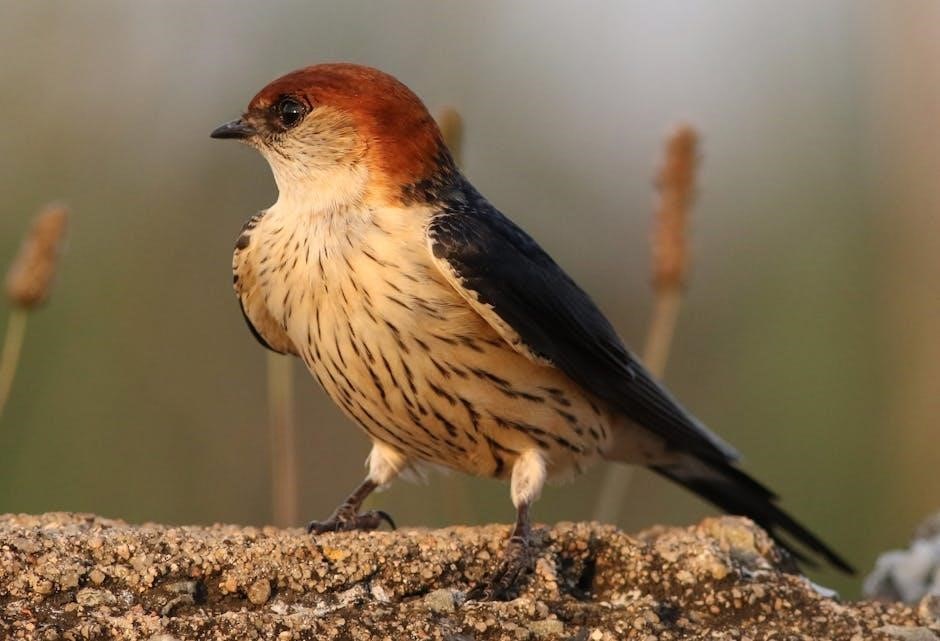
Identifying swallows requires observing plumage, flight patterns, and nesting habits. Key features include forked tails, streamlined bodies, and aerial agility; careful observation unlocks species distinctions.
Distinguishing Swallows from Similar Birds
Differentiating swallows from other aerial insectivores, like martins or even swifts, can be tricky. A primary distinction lies in the bill shape; swallows generally possess broader, flatter bills adapted for catching insects in flight, while swifts have smaller, more pointed bills. Observe the tail shape – swallows typically exhibit forked or deeply notched tails, aiding in maneuverability, a feature less pronounced in martins.
Flight patterns also offer clues. Swallows demonstrate more erratic, agile flight, frequently changing direction, whereas swifts maintain straighter, faster trajectories. Consider size; some swallow species are smaller than martins. Plumage variations can be subtle, but noting the presence of rufous coloration on the face or throat, common in certain swallows, can be helpful. Careful attention to these details, combined with habitat observation, will improve accurate identification.
Swallow Plumage Variations ー Age and Sex Differences
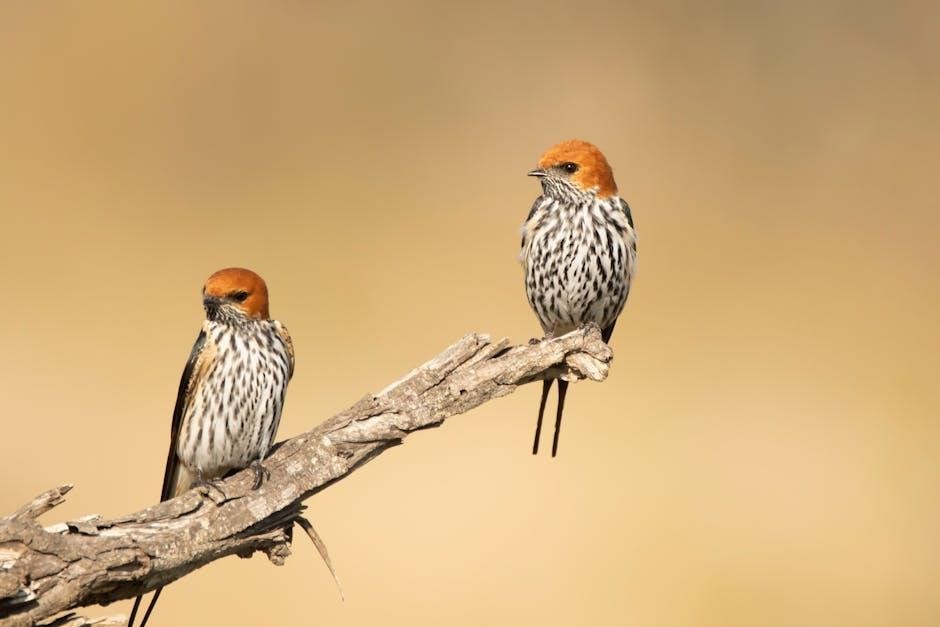
Swallow plumage exhibits fascinating variations linked to age and sex. Juvenile swallows often display duller coloration compared to adults, with less iridescent sheen and muted patterns. Their flight feathers may also show buffy edges, gradually fading with subsequent molts. These differences aid in identifying young birds still dependent on parental care.
Sexual dimorphism, while not always dramatic, can be present in some species. Male barn swallows, for instance, typically possess longer outer tail feathers – streamers – used in courtship displays, a feature less developed in females. However, plumage differences between sexes are often subtle and require close observation. Individual variation also exists, influenced by factors like diet and molt timing. Observing multiple individuals helps discern typical plumage characteristics within a specific population.
Swallow Size and Measurements
Swallow size varies considerably across different species, but generally, they are small to medium-sized birds. The barn swallow (Hirundo rustica), a commonly observed species, typically measures between 15-19 cm (5.9-7.5 inches) in length, with a wingspan of 32-34.5 cm (12.6-13.6 inches). Weight ranges from 16-22 grams (0.56-0.78 ounces).
Tree swallows (Tachycineta bicolor) are slightly smaller, averaging 13-15 cm (5.1-5.9 inches) in length. Cliff swallows (Petrochelidon pyrrhonota) are comparable in size to barn swallows. Bank swallows (Riparia riparia) are among the smallest, measuring around 12-14 cm (4.7-5.5 inches). These measurements provide a useful baseline for field identification, especially when combined with plumage characteristics and behavioral observations. Accurate size assessment aids in distinguishing swallows from similar-looking birds like martins or flycatchers.