This guide aims to simplify the basic steps of prayer in Islam, offering a foundational understanding for those beginning their spiritual journey.
Resources like the “How do I pray ⎻ a beginners guide to Islamic prayer through animation.pdf” provide accessible learning materials.
Understanding the importance of purification and intention is crucial before commencing prayer, as emphasized in various Islamic teachings and books.
What is Salah?
Salah, often translated as prayer, is one of the five pillars of Islam and a fundamental obligation for all Muslims. It’s a direct connection between the believer and Allah, a spiritual practice performed five times daily.
More than just ritualistic movements, Salah is a comprehensive act of worship encompassing physical postures, recitations from the Quran, and heartfelt supplications. It’s a means of seeking guidance, forgiveness, and expressing gratitude to the Creator.
For beginners, understanding Salah involves learning the proper procedures, timings, and conditions. Resources like downloadable PDF guides, such as “How do I pray ─ a beginners guide to Islamic prayer through animation,” can be incredibly helpful in grasping these fundamentals. The purpose is to establish a consistent and meaningful practice, strengthening one’s faith and relationship with Allah.
The Importance of Prayer in Islam
Prayer (Salah) holds paramount importance in Islam, considered the most vital act of worship after affirming faith in Allah. It’s a pillar upon which a Muslim’s spiritual life is built, fostering a constant awareness of God throughout the day.
The Quran emphasizes the significance of Salah, warning against neglecting it. It’s believed to cleanse the heart, prevent wrongdoing, and bring inner peace. Establishing prayer from the beginning of one’s faith journey is highly encouraged.
For beginners, understanding this importance motivates consistent practice. Resources like introductory PDF guides, and charitable projects focused on Islamic education, highlight prayer’s central role. A simple, easy-to-follow guide can help establish this crucial connection with the Divine, fostering a stronger spiritual foundation.
Preparation for Prayer
Purification, both physical and intentional, is essential before prayer. Resources like beginner’s PDF guides detail Taharah, ensuring readiness to connect with Allah.
Purification (Taharah) ⎻ Wudu (Ablution)
Wudu, or ablution, is a crucial purification ritual before Salah (prayer). Beginner’s guides, often available as PDF downloads, meticulously detail the steps. It begins with intention (niyyah) and involves washing specific body parts in a prescribed order.
First, wash both hands up to the wrists. Then, rinse the mouth thoroughly, followed by sniffing water into the nostrils and blowing it out. Next, wash the face from hairline to chin and ear to ear. After that, wash both arms up to the elbows, including the inner sides.
Subsequently, wipe the head with wet hands, starting from the forehead. Finally, wash both feet up to the ankles, ensuring water reaches between the toes. Proper Wudu ensures spiritual cleanliness and prepares the worshipper for a meaningful connection with Allah. PDF resources often include diagrams for clarity.
Purification (Taharah) ─ Ghusl (Full Bath)
Ghusl is a full-body ritual purification in Islam, required after major impurities like sexual activity, menstruation, or childbirth. Beginner’s guides, often found as PDFs, explain the process comprehensively. It’s more extensive than Wudu (ablution) and aims for complete physical and spiritual cleanliness.
Begin by making the intention (niyyah) to perform Ghusl for the sake of Allah. Then, wash the entire body with water, ensuring water reaches every part, including the scalp and inner ears. It’s recommended to start with washing the private parts, then perform Wudu as usual.
Finally, rinse the entire body thoroughly, ensuring no part remains dry. Ghusl is essential for resuming prayer and other acts of worship. Detailed PDF resources often provide visual aids and clarify specific rulings for different situations, ensuring proper adherence to Islamic guidelines.
Intention (Niyyah)
Niyyah, the intention, is a crucial element preceding every act of worship in Islam, including prayer. It’s a sincere resolve of the heart to perform the act solely for the pleasure of Allah. While not verbally pronounced, it’s a mental commitment that distinguishes a ritual act from a mundane one.
Beginner’s guides, often available as PDF downloads, emphasize that the Niyyah doesn’t alter the validity of the prayer if forgotten, but it enhances its spiritual reward. It’s about focusing the heart and mind on the act of worship, removing distractions and worldly thoughts.
Before starting prayer, silently formulate the intention to pray a specific prayer (e.g., Fajr, Dhuhr) for Allah’s sake. This internal declaration sets the stage for a mindful and devoted connection with the Divine, as detailed in many introductory Islamic resources.
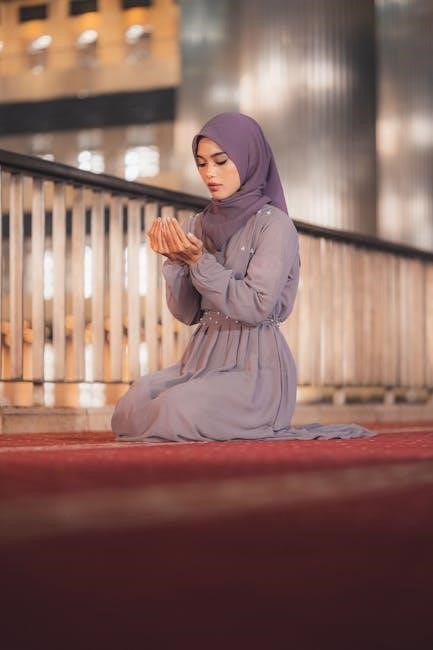
The Steps of Prayer (Salah)
Salah involves a sequence of actions: standing, reciting, bowing, prostrating, and sitting. Beginner’s PDF guides detail each step, emphasizing precise movements and recitations.
Standing (Qiyam)
Qiyam, the initial standing posture in Salah, is fundamental. Facing the Qibla (direction of the Kaaba), a Muslim begins with reverence and focus. Beginner’s guides, often available as PDF downloads, emphasize maintaining a composed and upright stance.
Hands are typically held gently, often described as placing the right hand over the left, though variations exist. This position symbolizes humility and devotion before Allah. The PDF resources highlight the importance of a calm and attentive heart during Qiyam, preparing for the recitation of the Quran.
It’s a time for internal reflection and acknowledging one’s dependence on God. The posture should be comfortable yet dignified, allowing for focused concentration. Animated tutorials often visually demonstrate the correct form for Qiyam, aiding beginners in understanding and practicing this essential element of Islamic prayer.
Opening Takbir (Takbirat al-Ihram)
The Opening Takbir, or Takbirat al-Ihram, marks the commencement of Salah. It’s the declaration, “Allahu Akbar” (God is the Greatest), uttered with sincerity and intention. Beginner’s PDF guides stress this isn’t merely a phrase, but a transition into a sacred state.
Raising the hands to ear level while saying “Allahu Akbar” is the common practice, though slight variations are permissible. This action signifies severing ties with worldly distractions and focusing solely on Allah; Resources emphasize the importance of clear pronunciation and a mindful heart.
The Takbir signifies entering into direct communication with the Divine. Animated tutorials often demonstrate the hand movements accompanying the Takbir. This initial act sets the tone for the entire prayer, establishing reverence and submission. It’s a crucial step for beginners to master.
Recitation of Surah al-Fatiha
Following the Takbirat al-Ihram, the recitation of Surah al-Fatiha is obligatory in every rak’ah (unit of prayer). Often called the “Opening,” this seven-verse chapter from the Quran is central to Islamic prayer. Beginner’s PDF guides frequently include the Arabic text alongside transliteration and translation to aid learning.
Surah al-Fatiha is a plea for guidance, seeking Allah’s blessings and mercy. Resources highlight the importance of reciting it correctly, with proper pronunciation and understanding of its meaning. Animated tutorials demonstrate the correct articulation of each verse.
Even for those new to Arabic, memorizing Surah al-Fatiha is highly encouraged. It’s considered the foundation of the Quran and a direct conversation with Allah. Simple language books often provide step-by-step guidance for memorization and recitation.
Recitation of Quranic Verses
After Surah al-Fatiha, reciting additional verses from the Quran is customary, though not obligatory. Beginner’s guides, including PDF downloads, often suggest short surahs (chapters) suitable for initial learning. Examples are frequently provided in the final chapters of these introductory materials.
The choice of verses is flexible, allowing for variety in each prayer. Many resources recommend starting with shorter surahs like Surah An-Nas or Surah Al-Ikhlas, as they are relatively easy to memorize. Animated tutorials can aid in proper pronunciation.
Islamic charitable projects often distribute simplified books with transliteration and translation to facilitate understanding. The goal is to connect with the Quran’s message, even while learning the Arabic language. Consistent practice, guided by these resources, builds confidence.
Bowing (Ruku)
Following the recitation, the worshipper descends into Ruku – the bowing position. This involves bending from the waist, keeping the back relatively straight, and placing the hands on the knees. Beginner’s guides, often available as PDFs, emphasize maintaining a natural curve in the spine.
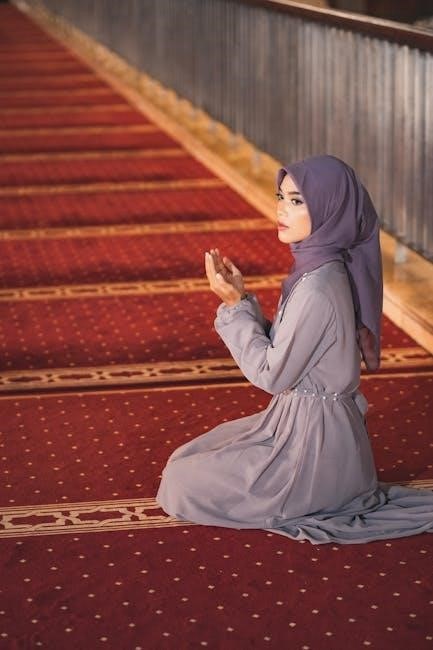
Animated tutorials visually demonstrate the correct form, highlighting the importance of a respectful and humble posture. It’s crucial to ensure the back and neck are aligned, avoiding strain. During Ruku, it is essential to glorify Allah, commonly reciting “Subhana Rabbi al-Azim” (Glory be to my Lord, the Magnificent).
Islamic resources stress that Ruku is a demonstration of submission and reverence. Simplified books often include illustrations and step-by-step instructions for beginners, ensuring proper execution of this vital component of prayer.
Prostration (Sujud)
After rising from Ruku, the worshipper proceeds to Sujud – prostration. This involves lowering the forehead, nose, palms, knees, and toes to the ground simultaneously. Beginner’s guides, frequently found as PDF downloads, illustrate the correct positioning, emphasizing a gentle and controlled descent.
Animated tutorials demonstrate the precise placement of body parts, ensuring proper form. During Sujud, it’s essential to glorify Allah, often reciting “Subhana Rabbi al-A’la” (Glory be to my Lord, the Most High). Islamic resources highlight Sujud as the closest a believer comes to Allah.

Simplified books often detail the etiquette of Sujud, including keeping elbows close to the body and avoiding unnecessary movements. Proper Sujud demonstrates complete humility and submission, a cornerstone of Islamic prayer, as explained in many introductory materials.
Sitting Between Prostrations (Jalsa)
Following the first Sujud, the worshipper sits briefly in a position called Jalsa. Beginner’s guides, often available as PDFs, detail two common postures: sitting on the left buttock with the right foot upright, or tucking both feet to the left. Animated tutorials visually demonstrate these positions for clarity.
During Jalsa, it’s recommended to say “Rabbighfir li, Rabbighfir li” (My Lord, forgive me, My Lord, forgive me). Islamic resources emphasize this as a time for seeking forgiveness and reflecting on one’s connection with Allah. Simplified books often highlight the importance of maintaining composure during this pause.
The duration of Jalsa is relatively short, preparing for the second prostration. Proper execution, as illustrated in introductory materials, ensures a smooth and focused flow within the prayer, demonstrating reverence and attentiveness.
Final Tashahhud
The Final Tashahhud is a crucial part of Salah, recited while sitting during the last Rakah. Beginner’s guides, including downloadable PDFs, provide the Arabic text and its transliteration for ease of learning. It begins with “Attahiyyatulillah…” and affirms faith in Allah and His Messenger.
Animated tutorials often visually demonstrate the correct posture – sitting with knees bent and left foot flat on the ground, right foot upright. Resources emphasize the importance of reciting the Tashahhud with presence of heart and understanding its meaning.
Following the core Tashahhud, blessings are invoked upon the Prophet Muhammad (peace be upon him). Simplified books highlight this as a demonstration of love and respect. Accurate pronunciation, as found in learning materials, is highly encouraged.
Salutations (Taslim)
Taslim, the final act of Salah, signifies completion of the prayer and a turning towards peace. Beginner’s guides and PDF resources detail turning the head to the right, saying “Assalamu alaikum wa rahmatullah” (peace and blessings be upon you), and then repeating to the left.
Animated tutorials visually demonstrate the head movements, emphasizing a gentle turn, not a full body rotation. The intention behind Taslim is to greet the angels recording deeds and fellow worshippers. Simplified books explain this as a gesture of respect and brotherhood.
Some scholars recommend offering Taslim to those present, while others focus on the angelic recipients. Learning materials often present both perspectives. Correct performance of Taslim, as outlined in instructional materials, ensures the prayer is validly concluded.
Types of Prayers (Salah)
Islamic prayer consists of five daily obligations: Fajr, Dhuhr, Asr, Maghrib, and Isha. Beginner PDF guides detail each prayer’s specific timings and rak’ahs (cycles).
Fajr (Dawn Prayer)

Fajr, the dawn prayer, holds a special significance in Islam, often emphasized as a means of seeking blessings and spiritual strength for the day ahead. Beginner’s guides, including readily available PDF resources, detail that Fajr consists of two rak’ahs (cycles) performed between the true dawn (subh sadiq) and sunrise.
These guides typically illustrate the proper sequence, starting with the intention (niyyah) and wudu (ablution). The prayer begins with the opening takbir, followed by reciting Surah al-Fatiha and a portion of the Quran. PDF tutorials often include animations demonstrating the correct posture during ruku (bowing) and sujud (prostration).
Many resources highlight the importance of performing Fajr on time, as it is considered a highly rewarded act of worship. Simple language and clear illustrations in these beginner materials aim to make learning Fajr accessible to all, fostering a consistent prayer habit from the start.
Dhuhr (Midday Prayer)
Dhuhr, the midday prayer, comprises four rak’ahs (cycles) and is performed after the sun has passed its zenith. Beginner’s guides and PDF downloads emphasize its importance as a pillar of daily worship. These resources detail the complete process, beginning with wudu (ablution) and the intention (niyyah).
Like other prayers, Dhuhr starts with the opening takbir, followed by reciting Surah al-Fatiha and verses from the Quran. PDF tutorials often visually demonstrate the correct form for ruku (bowing) and sujud (prostration), ensuring proper execution.
Many guides stress the significance of performing Dhuhr within its prescribed time. The simplicity of language and step-by-step instructions in these materials are designed to help beginners establish a consistent prayer routine. Resources also mention the possibility of shortening Dhuhr to two rak’ahs during travel.
Asr (Afternoon Prayer)
Asr, the afternoon prayer, consists of four rak’ahs, though it can be shortened to two when traveling, as detailed in beginner’s guides and PDF resources. These materials emphasize the importance of performing Asr before the sun begins to turn yellow. The guides often include visual aids demonstrating the correct posture for each step.
Like other obligatory prayers, Asr begins with wudu (ablution) and a sincere intention (niyyah). The prayer follows the standard format: takbirat al-ihram, recitation of Surah al-Fatiha, and additional Quranic verses. PDF tutorials highlight the proper way to transition between standing (qiyam), bowing (ruku), and prostration (sujud).
Many resources stress the significance of maintaining consistency in performing Asr, even when facing challenges. The aim is to establish a strong connection with Allah through this daily ritual, and beginner guides offer encouragement and support.

Maghrib (Sunset Prayer)
Maghrib, the sunset prayer, comprises three rak’ahs. Beginner’s guides and downloadable PDFs often illustrate the timing, emphasizing performing it immediately after sunset, before the twilight fades. These resources frequently include diagrams showing the correct positioning and movements during each rak’ah.
The structure of Maghrib prayer mirrors other obligatory prayers: beginning with wudu and niyyah, followed by the opening takbir and recitation of Surah al-Fatiha, alongside additional verses from the Quran. Animated tutorials, available as PDFs, demonstrate the smooth transitions between postures.
Islamic charitable projects often distribute simplified prayer guides, stressing the importance of consistency. These materials highlight that Maghrib is a vital opportunity for seeking forgiveness and gratitude, reinforcing the spiritual benefits of regular prayer.
Isha (Night Prayer)
Isha, the night prayer, consists of four rak’ahs and is performed after complete darkness has settled. Beginner’s PDF guides emphasize the importance of performing Isha before sleeping, as it’s considered a protected time. These resources often detail the preferred timings and offer visual aids for correct posture.
Like other prayers, Isha begins with purification (wudu) and sincere intention (niyyah), followed by the opening takbir and recitation of Surah al-Fatiha, supplemented by verses from the Quran. Animated tutorials, frequently found in downloadable PDFs, illustrate the movements clearly.
Islamic charitable projects often provide simplified prayer guides, highlighting the spiritual significance of Isha. These materials stress the opportunity for deep reflection and connection with Allah during the tranquility of the night, reinforcing the benefits of consistent prayer.

Resources for Learning
Numerous beginner’s guides and PDF downloads simplify Islamic prayer, while online tutorials and animations offer visual learning experiences for newcomers.
Accessible resources aid understanding.
Beginner’s Guides & PDF Downloads
For those embarking on learning Islamic prayer, readily available beginner’s guides and PDF downloads offer structured instruction. A particularly helpful resource is “How do I pray ─ a beginners guide to Islamic prayer through animation.pdf”, providing a visual and accessible introduction to the steps involved.
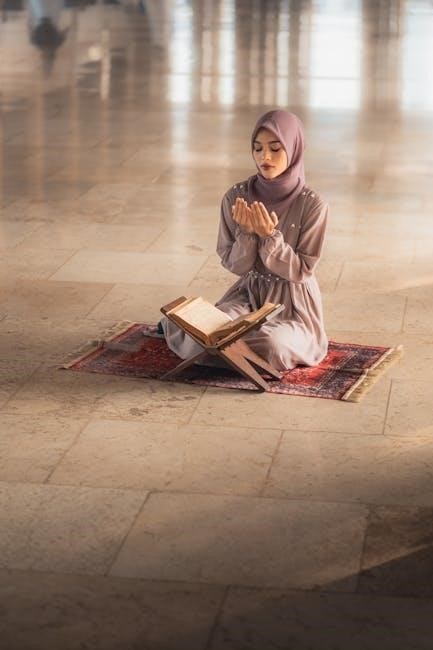
These downloadable materials often break down the complexities of Salah into manageable sections, covering topics from purification (Taharah) and intention (Niyyah) to the precise movements and recitations. Many guides emphasize the importance of praying with sincerity and devotion, focusing on the spiritual connection with Allah.
PDF formats allow for convenient offline access and repeated review, aiding in memorization and practical application. Look for guides that include illustrations or diagrams to further clarify the physical postures of prayer. These resources are invaluable tools for establishing a consistent and correct prayer practice.
Online Tutorials & Animations
Complementing PDF guides, numerous online tutorials and animations provide dynamic learning experiences for beginners in Islamic prayer. Visual learners particularly benefit from these resources, which demonstrate the correct postures and movements of Salah step-by-step.
Many websites and platforms offer comprehensive courses, often featuring video lectures and interactive exercises. These tutorials frequently cover the essential elements, including Wudu (ablution), Niyyah (intention), and the sequence of actions within the prayer itself. The “How do I pray ─ a beginners guide to Islamic prayer through animation.pdf” hints at the power of animated learning.
Online resources allow for pausing, rewinding, and repeating sections as needed, fostering a deeper understanding. Searching for “Islamic prayer tutorial” or “Salah for beginners” will yield a wealth of options, catering to diverse learning styles and preferences.