VITA Classical represents the original standard for precise tooth color matching, offering a reliable system for dental professionals globally.
This guide, including VITA Bleached Shades, facilitates accurate shade determination, even after whitening procedures, ensuring aesthetic restorative outcomes.
The A1-D4 arrangement provides a systematic approach, while its convenience allows for quick and effective shade measurements in clinical practice.
Historical Significance of the VITA Classical System
The VITA Classical Shade Guide, introduced decades ago, revolutionized restorative dentistry by establishing a standardized approach to tooth shade selection. Prior to its development, shade matching relied heavily on subjective visual assessments, leading to inconsistencies and often unsatisfactory aesthetic results.
VITA recognized the need for a systematic and reproducible method, meticulously researching and categorizing natural tooth shades. This culminated in the creation of the A1-D4 system, which quickly became the gold standard embraced by dental laboratories and clinicians worldwide.
Its enduring legacy stems from its simplicity, comprehensiveness, and ability to facilitate effective communication between dentists and technicians. The system’s influence extends beyond direct shade matching, impacting the development of subsequent shade guides and digital colorimetry technologies. Even with advancements, the VITA Classical remains a foundational tool, representing a pivotal moment in the pursuit of lifelike dental restorations.
The Importance of Accurate Shade Matching
Achieving accurate shade matching is paramount in restorative and cosmetic dentistry, directly impacting the aesthetic success and patient satisfaction. A poorly matched restoration, even with excellent function, can appear unnatural and detract from the overall smile harmony.
The VITA Classical Shade Guide facilitates this crucial process by providing a systematic framework for analyzing and replicating natural tooth color. Precise shade selection minimizes discrepancies, ensuring restorations blend seamlessly with the surrounding dentition.
Furthermore, accurate shade matching is particularly challenging with composite materials, requiring careful consideration of factors like lighting and material properties. Utilizing a standardized guide like VITA Classical, alongside techniques for value assessment, significantly improves the predictability of achieving a natural and aesthetically pleasing outcome. Ultimately, meticulous shade matching demonstrates a commitment to quality and patient-centered care.

Understanding the VITA Classical A1-D4 Shade Guide
VITA Classical employs an A1-D4 system, categorizing shades by hue and value; A shades are reddish-brown, while D shades lean towards grey.
Overview of the A1-D4 System
The VITA Classical A1-D4 shade guide is a foundational tool in restorative dentistry, meticulously designed for accurate tooth shade determination. This system organizes shades into four primary groups: A, B, C, and D, each representing a distinct hue. The ‘A’ group exhibits reddish-brown tones, commonly found in many natural teeth. ‘B’ shades present a reddish-yellow hue, while ‘C’ shades lean towards grey. Finally, ‘D’ shades demonstrate a greyish-brown character.
Each of these main groups is further subdivided into four levels – 1, 2, 3, and 4 – indicating changes in value, or lightness. Lower numbers (1 and 2) represent lighter shades, while higher numbers (3 and 4) denote progressively darker tones. This hierarchical structure allows for nuanced shade selection, enabling clinicians to closely match the patient’s existing dentition. The systematic arrangement ensures a comprehensive and logical approach to shade matching, contributing to highly aesthetic restorative results.
The Four Main Shade Groups: A, B, C, and D
The VITA Classical shade guide categorizes tooth shades into four principal groups – A, B, C, and D – based on their dominant hue. The ‘A’ group embodies reddish-brown shades, frequently observed in youthful, vital teeth. These shades often require minimal modification for excellent aesthetic outcomes. The ‘B’ group showcases reddish-yellow hues, representing a warmer tone commonly found in natural dentition.
In contrast, the ‘C’ group presents a range of greyish shades, often seen in older individuals or teeth with increased opacity. Finally, the ‘D’ group encompasses reddish-grey tones, representing a darker, more saturated hue. Understanding these fundamental differences is crucial for accurate shade selection. Each group provides a starting point, allowing clinicians to narrow down the possibilities and achieve a harmonious blend with the surrounding teeth, ultimately enhancing the restorative result.
Subdivisions Within Each Group: 1, 2, 3, and 4
Within each of the primary shade groups (A, B, C, and D) of the VITA Classical guide, further refinement is achieved through numerical subdivisions – 1, 2, 3, and 4. These numbers represent changes in value, or lightness. A ‘1’ shade signifies the lightest value within that group, progressing to ‘4’ which denotes the darkest.
This systematic progression allows for nuanced shade matching, accounting for variations in tooth translucency and brightness. For instance, A1 is a light reddish-brown, while A4 is a darker, more saturated reddish-brown. This hierarchical structure ensures clinicians can precisely replicate the natural tooth’s color, considering subtle differences. Mastering this system is vital for achieving lifelike restorations and a seamless aesthetic integration with the patient’s existing dentition.
Detailed Breakdown of Each Shade
VITA Classical shades—A1 through D4—offer a spectrum of color options, categorized by hue, chroma, and value, for precise restorative matching.
Each shade possesses unique characteristics, enabling clinicians to replicate natural tooth aesthetics effectively and consistently.
A1 Shade Characteristics
A1 is arguably the most frequently requested shade, representing a light, vibrant, and highly saturated color within the VITA Classical system.
Characterized by a reddish-brown hue, A1 exhibits a significant amount of chroma, making it appear bright and lively. Its high value contributes to its lightness.
Clinicians often describe A1 as the shade for youthful, natural-looking teeth, frequently found in younger patients. However, it’s crucial to remember that individual tooth shades vary.
Successfully replicating A1 requires careful consideration of the surrounding teeth and the overall patient complexion. It’s a popular choice for anterior restorations where a bright, aesthetic result is desired.
Due to its prominence, mastering the nuances of A1 is fundamental for any dental professional utilizing the VITA Classical shade guide.
A2 Shade Characteristics
A2, within the VITA Classical system, presents a slightly more saturated and warmer tone compared to A1, still falling within the reddish-brown shade group.
While retaining a relatively high value, A2 exhibits a subtle decrease in lightness, offering a more natural appearance for many patients. It’s a versatile shade frequently observed in adult dentition.
Compared to A1, A2 possesses a slightly lower chroma, resulting in a less vibrant, yet still aesthetically pleasing, color. This makes it suitable for a broader range of cases.
Clinicians often select A2 when a bright, youthful shade isn’t desired, or when matching existing restorations that are slightly less saturated. It’s a reliable and commonly used shade.
Understanding the subtle differences between A1 and A2 is crucial for achieving accurate and harmonious shade matching with the VITA Classical guide.
A3 Shade Characteristics
A3, within the VITA Classical shade guide, represents a noticeable shift towards a more chromatic and less luminous hue compared to A1 and A2. It remains within the reddish-brown family, but with increased intensity.
This shade is characterized by a lower value – meaning it’s darker – and a higher chroma, resulting in a more saturated and warmer appearance. A3 is frequently found in more aged or stained dentition.
Clinicians often utilize A3 when matching teeth exhibiting moderate staining or discoloration, or when a more robust shade is required for restorative work. It provides depth and character.
Compared to lighter A shades, A3 offers a more natural look for patients with existing darker teeth, avoiding an unnatural brightness. Careful consideration of surrounding shades is key.
Mastering the nuances of A3 is vital for achieving realistic and aesthetically pleasing restorations with the VITA Classical system.
A4 Shade Characteristics
A4 represents the darkest and most saturated shade within the A group of the VITA Classical shade guide. It maintains the reddish-brown hue characteristic of the A family, but with significantly reduced value and increased chroma.
This shade is notably darker and more intense than A1, A2, and A3, making it suitable for matching heavily stained or naturally darker teeth. It’s often used for cervical areas or in cases requiring substantial opacity.
Clinicians should exercise caution when selecting A4, as its darkness can easily overpower surrounding lighter shades. It’s best utilized when matching existing darker dentition or creating deliberate characterization.
A4 provides a strong base for layering techniques, allowing for the creation of realistic and individualized restorations. It’s crucial to assess the overall color scheme before committing to this shade.
Understanding A4’s properties is essential for achieving natural-looking results with the VITA Classical system, particularly in complex cases.
B1 Shade Characteristics
B1, within the VITA Classical shade guide, is characterized by a reddish-yellowish hue, positioning it within the B group. It’s generally brighter and more vibrant than shades in the A group, offering a warmer tone.
Compared to A1, B1 exhibits a yellower cast, making it suitable for matching teeth with a similar warm undertone. It’s a popular choice for anterior restorations aiming for a youthful and natural appearance.
B1 possesses a moderate value and chroma, providing versatility in various clinical scenarios. It’s often used for incisors and canines, particularly in patients with warmer skin tones.
Careful consideration of surrounding teeth and the overall facial aesthetics is crucial when selecting B1. It’s important to avoid over-saturation, which can result in an unnatural appearance.
Mastering B1’s characteristics is key to achieving harmonious and aesthetically pleasing restorations using the VITA Classical system.
B2 Shade Characteristics
B2, a shade within the VITA Classical system, continues the reddish-yellowish trend of the B group, but with a slightly decreased brightness compared to B1. It presents a warmer tone, though less vibrant, making it a versatile option.
Compared to B1, B2 exhibits a subtly lower value and chroma, resulting in a more subdued yet still warm appearance. This makes it suitable for patients needing a natural, but not overly bright, restoration.
B2 is frequently utilized for incisors and canines, particularly when a slightly more mature or less-saturated shade is desired. It blends well with existing dentition possessing similar characteristics.
When selecting B2, clinicians should assess the patient’s overall complexion and the surrounding teeth to ensure a harmonious match. Avoiding excessive warmth is crucial for a natural result;
Understanding B2’s nuances is vital for achieving aesthetically pleasing restorations with the VITA Classical guide.
B3 Shade Characteristics
B3, within the VITA Classical shade guide, represents a further reduction in both value and chroma compared to B2, maintaining the reddish-yellowish hue characteristic of the B group. It’s noticeably less bright and saturated.
This shade is often selected when a more subdued, natural appearance is desired, particularly in patients with moderately stained or discolored teeth. B3 offers a warmer alternative to the greyer C shades.
Compared to B2, B3 exhibits a more muted tone, making it suitable for restorations requiring a less prominent appearance. It’s frequently used for posterior teeth or areas needing a subtle shade match.
Clinicians should carefully evaluate the patient’s existing dentition and skin tone when considering B3, ensuring it complements the overall aesthetic. Proper lighting is crucial for accurate assessment.
Mastering B3’s characteristics is key to achieving lifelike restorations using the VITA Classical system.
B4 Shade Characteristics
B4 represents the darkest and most saturated shade within the B group of the VITA Classical shade guide. Maintaining the reddish-yellowish character of the B shades, B4 exhibits a significantly lower value and increased chroma compared to lighter B shades.

This shade is typically selected for patients with heavily stained or naturally darker teeth, or when a more pronounced contrast is desired. It’s less commonly used for anterior restorations due to its intensity.
Compared to B3, B4 presents a richer, deeper color, requiring careful consideration to avoid an unnatural appearance. It’s often utilized in posterior restorations or as a cervical shade.
Accurate shade matching with B4 demands meticulous attention to lighting and surrounding tooth structure. Clinicians must assess the overall aesthetic context to ensure harmony.
Understanding B4’s unique properties is vital for achieving predictable and aesthetically pleasing results with the VITA Classical system.
C1 Shade Characteristics
C1 is the lightest and most saturated shade within the C group of the VITA Classical shade guide, characterized by its grayish hue. Unlike the warmer A and B shades, C1 possesses a noticeable translucency and reduced chroma, making it suitable for specific clinical scenarios.
This shade is frequently selected for patients exhibiting grayish or slightly desaturated natural teeth, or when attempting to match existing ceramic restorations with similar characteristics.
Compared to A1 or B1, C1 offers a cooler, more subdued aesthetic. It’s often used for incisal edges or as a modifier shade to neutralize warmth.
Careful consideration of lighting is crucial when utilizing C1, as its grayish tone can appear different under varying illumination. Accurate assessment of surrounding teeth is essential.
Mastering C1’s properties allows clinicians to achieve nuanced and lifelike restorations with the VITA Classical system.
C2 Shade Characteristics
C2, within the VITA Classical shade guide, represents a slightly more saturated and warmer tone compared to C1, while still maintaining a predominantly grayish character. It’s positioned as a transitional shade within the C group, offering a balance between coolness and chroma.
Clinically, C2 is often selected for patients with moderately grayish teeth exhibiting a subtle warmth. It’s a versatile option for restorations requiring a natural, yet subdued appearance.
Compared to C1, C2 demonstrates a reduced translucency and a slight increase in value, making it appear less bright. It’s frequently used for cervical areas or as a body shade.
Proper lighting is vital when assessing C2, as its grayish undertones can be influenced by ambient conditions; Careful observation of adjacent teeth is crucial for accurate matching.
Understanding C2’s nuances enhances restorative outcomes using the VITA Classical system.
C3 Shade Characteristics
C3, within the VITA Classical shade guide, presents a distinctly grayish hue with a moderate level of chroma and value. It’s noticeably darker and more saturated than C2, leaning towards a more pronounced gray appearance.
Clinically, C3 is frequently chosen for patients exhibiting significant grayness in their dentition, often found in individuals with aged or tetracycline-stained teeth. It’s suitable for creating restorations that blend seamlessly with such cases.
Compared to other shades, C3 possesses reduced translucency and a higher opacity, making it ideal for blocking out underlying discolorations. It’s often utilized as a dentin shade in layered restorations.
Accurate shade matching with C3 requires careful consideration of lighting conditions, as gray shades are particularly sensitive to environmental influences. Consistent illumination is paramount.
Mastering C3’s characteristics is key to achieving natural-looking restorations with the VITA Classical system.
C4 Shade Characteristics
C4 represents the darkest and most saturated shade within the C group of the VITA Classical shade guide. It exhibits a strong grayish character, possessing minimal warmth and a notably reduced value compared to lighter shades like C1 or C2.
Clinically, C4 is reserved for cases with heavily stained or severely discolored teeth, or for patients with naturally darker dentition. It’s often employed in the cervical areas of teeth to mimic natural shadow and depth;
Due to its high chroma and low value, C4 requires careful application to avoid creating restorations that appear unnatural or overly dark. It’s frequently used in combination with other shades for a more lifelike result.
When selecting C4, meticulous attention to lighting is crucial, as its grayness can be easily influenced by ambient conditions. Proper shade tabs are essential for accurate assessment.
C4 is a powerful tool within the VITA Classical system, demanding skillful application for optimal aesthetic outcomes.
D2 Shade Characteristics

D2, within the VITA Classical shade guide, represents a reddish-gray hue, positioned as a transitional shade between the warmer B shades and the cooler C group. It exhibits a lower value (darkness) than shades A2 or B2, but retains a degree of warmth not found in the C shades.
Clinically, D2 is frequently selected for patients with moderately stained teeth or those exhibiting a grayish undertone to their natural dentition. It’s often used in incisal edges to replicate subtle translucency and characterization.
Compared to D3 or D4, D2 offers a more natural appearance, avoiding the potential for restorations to appear overly dark or opaque. Careful consideration of lighting is vital when assessing this shade.
D2’s unique color profile makes it a versatile option for achieving lifelike restorations, particularly in cases requiring a balance of warmth and coolness.
Mastering D2 selection enhances the clinician’s ability to achieve harmonious shade matching with the VITA Classical system.
D3 Shade Characteristics
D3, within the VITA Classical shade guide, is characterized as a reddish-gray shade, exhibiting a noticeably lower value (darker appearance) than D2. It possesses a stronger gray component, making it suitable for patients with significant staining or naturally darker teeth.
Clinically, D3 is often selected for cervical areas or root restorations where a darker, more opaque shade is desired to mimic the underlying dentin. It’s crucial to assess D3 under proper lighting to avoid misinterpretation.
Compared to D4, D3 offers a slightly warmer tone, preventing restorations from appearing overly ashen. However, it’s essential to consider the surrounding teeth and overall aesthetic goals.
D3’s unique color properties require careful evaluation and skillful application to achieve natural-looking results. It’s a valuable option for complex cases demanding precise shade matching.
Understanding D3’s nuances is key to successful restorative outcomes using the VITA Classical system.

D4 Shade Characteristics
D4 represents the darkest shade within the VITA Classical A1-D4 system, categorized as a reddish-gray. It exhibits a significantly reduced value – meaning it’s notably darker – and a pronounced gray hue, making it ideal for specific clinical scenarios.
D4 is frequently utilized for heavily stained teeth, root canal treated teeth exhibiting discoloration, or when mimicking the shade of cementum in certain restorative cases. Careful consideration is needed, as it can appear quite dark if not appropriately applied.
Compared to D3, D4 possesses a cooler tone, leaning more towards gray and less towards reddish undertones. This makes it suitable for patients with minimal warmth in their natural dentition.
Accurate shade selection with D4 requires meticulous attention to lighting and surrounding tooth colors to avoid an unnatural appearance. It’s a powerful tool when used judiciously.
Mastering D4’s characteristics is vital for achieving optimal aesthetic results with the VITA Classical guide.
VITA Bleached Shades Integration
VITA Bleached Shades (0M1, 0M2, 0M3) expand the VITA Classical system, enabling precise shade matching for post-whitening restorations and treatments.
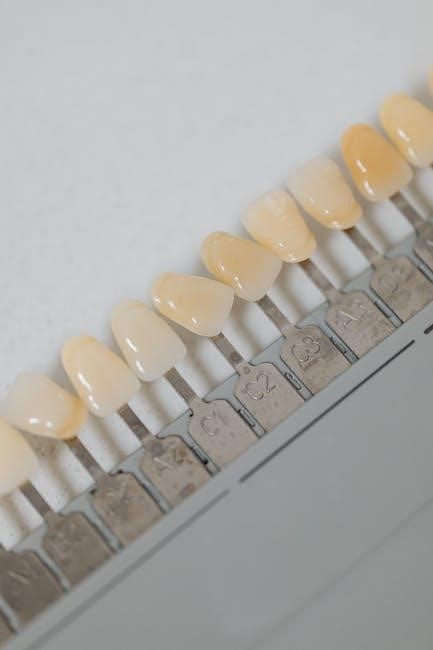
VITA Bleached Shades represent a significant extension to the established VITA Classical shade guide, specifically addressing the needs of modern aesthetic dentistry. These shades – 0M1, 0M2, and 0M3 – were developed to accurately represent the color range achieved after tooth whitening procedures, a common pre-restorative step;
Prior to their introduction, dentists often struggled to find suitable matches within the traditional A1-D4 spectrum for bleached teeth. The VITA Bleached Shades, derived from the VITA SYSTEM 3D-MASTER, offer a dedicated palette for these lighter, often more translucent, hues. They are designed to seamlessly integrate with existing VITA Classical guides, providing a comprehensive solution for shade selection.
These shades aren’t simply lighter versions of existing colors; they possess unique chromatic characteristics reflecting the altered optical properties of bleached enamel and dentin.
Retrofitting the Classical Guide with Bleached Shades
The beauty of the VITA system lies in its adaptability. Existing users of the VITA Classical A1-D4 shade guide or the VITAPAN classical don’t need to replace their entire system to incorporate bleached shade options. VITA Bleached Shades are specifically designed for retrofitting, offering a cost-effective upgrade path.
These shades are available as a separate set, complete with dedicated holders, allowing for easy integration into your current workflow. Simply add the 0M1, 0M2, and 0M3 shades alongside your existing tabs, expanding your shade-matching capabilities. This modular approach ensures a smooth transition and maximizes the value of your initial investment.
Retrofitting maintains consistency and familiarity, allowing clinicians to leverage their existing expertise while embracing advancements in shade technology.
Using Bleached Shades for Post-Whitening Shade Selection
Following tooth whitening, traditional shade guides often fall short, as bleached shades exist outside the conventional A1-D4 range. The VITA Bleached Shades (0M1, 0M2, 0M3) were specifically created to address this challenge, providing accurate matches for post-bleaching restorations.
These shades represent the lighter, more translucent hues achieved through whitening, enabling dentists to select restorative materials that seamlessly blend with the patient’s new smile. Utilizing these shades minimizes discrepancies and ensures a natural-looking result.
By incorporating VITA Bleached Shades into your shade-taking protocol after whitening, you can confidently deliver restorations that harmonize with the revitalized tooth color, enhancing patient satisfaction and aesthetic outcomes.

Practical Applications and Considerations
VITA Classical guides are essential for shade selection, but composite matching presents unique challenges; lighting significantly impacts accurate shade determination in clinical settings.
Shade Selection Techniques with the VITA Classical Guide
Effective shade selection with the VITA Classical guide requires a systematic approach. Begin by isolating the tooth and ensuring a clean, dry surface. Utilize consistent, diffused lighting – avoiding direct sunlight or strong artificial sources – as these can distort color perception.
Systematically compare the natural tooth to the VITA shade tabs, viewing them under standardized conditions. Consider the tooth’s value, chroma, and hue. It’s often beneficial to assess the shade against multiple tabs simultaneously, narrowing down the closest match.
Furthermore, hydrate the shade tabs with water or a try-in paste to mimic the natural translucency of teeth. Record the selected shade alongside any relevant clinical notes for accurate reproduction during restorative procedures. Multiple views and assessments are crucial for optimal results.
Challenges in Shade Matching with Composite Materials
Achieving a precise shade match with composite resins presents unique difficulties compared to porcelain restorations. Composites exhibit varying translucency and opacity, influenced by filler particle size and resin matrix. This inherent characteristic can make direct comparison to the VITA Classical shades challenging.
Furthermore, composites are susceptible to dehydration during placement and polymerization, potentially altering their initial shade. Layering techniques, utilizing different composite shades to mimic natural tooth structure, are often necessary to achieve optimal aesthetics.
Proper light curing is also critical; insufficient or excessive curing can impact shade stability. Careful consideration of the composite’s optical properties and meticulous technique are essential for successful shade matching, even when guided by the VITA system.
The Role of Lighting in Shade Determination
Accurate shade selection using the VITA Classical guide is profoundly impacted by the quality and characteristics of lighting. Conventional operatory lighting often contains a spectral bias, distorting perceived colors and leading to inaccurate matches.
Ideally, shade matching should be performed under standardized daylight conditions – approximately 5500K with a high Color Rendering Index (CRI) of 93 or greater. Avoiding ambient light and utilizing a consistent light source minimizes metamerism, where two colors appear to match under one light but differ under another.
Diffused lighting is preferable to direct illumination, reducing glare and shadows. Careful attention to lighting ensures reliable shade selection with the VITA system, contributing to aesthetically pleasing restorative outcomes.

Resources and Further Information
VITA Dental’s website provides comprehensive materials and educational resources on the VITA Classical shade guide and related systems for professionals.
Clinical studies validating shade matching accuracy are available through dental journals and research databases, supporting evidence-based practice.
VITA Dental Website and Materials
VITA Dental’s official website serves as a central hub for detailed information regarding the VITA Classical Shade Guide and its associated products. Users can access comprehensive documentation, including downloadable guides, technical specifications, and frequently asked questions addressing common shade-matching challenges.
The website features a dedicated section showcasing the evolution of the VITA shade systems, from the original Classical guide to the advanced 3D-Master and VITA BleachedShades. Professionals can explore interactive tools, such as virtual shade tabs and colorimetric comparisons, to enhance their understanding and refine their shade selection skills.
Furthermore, VITA Dental offers a range of physical materials, including shade guides, individual shade tabs, and instructional videos, available for purchase through authorized distributors. These resources are designed to support dental teams in achieving consistently accurate and aesthetically pleasing restorative results with the VITA Classical system.
Clinical Studies on Shade Matching Accuracy
Numerous clinical studies have investigated the reliability and accuracy of the VITA Classical Shade Guide in achieving successful shade matching. Research consistently demonstrates its effectiveness as a foundational tool, though acknowledges inherent challenges, particularly with composite materials. Studies highlight inter-examiner variability, emphasizing the importance of standardized protocols and training.
Investigations have explored the impact of factors like lighting conditions and observer experience on shade perception when utilizing the VITA system. Some research focuses on comparing the Classical guide’s performance against newer, more technologically advanced shade-matching systems, assessing both accuracy and efficiency.
Furthermore, studies examining the integration of VITA BleachedShades reveal improved shade selection outcomes following tooth whitening treatments, confirming its value in modern restorative dentistry. Accessing these studies provides evidence-based insights for optimizing shade matching techniques.